

Published May 21, 2026 01:30PM
Turn your gaze upward at night and what you experience goes beyond the glimmering stars and planets that you can see. Within that infinite expanse are ancient patterns and unfolding cycles against a backdrop of constellations that map discrete sections of space. These clusters of stars, each comprising a different zodiac sign, have been recognized by humans by thousands of years through mythology, storytelling, spiritual teachings, navigational methods, agricultural systems, and more. According to astrology, these signs are what afford us valuable insights into our existence, and part of what helps us understand our unique role are our birth charts.
So What is a Birth Chart?
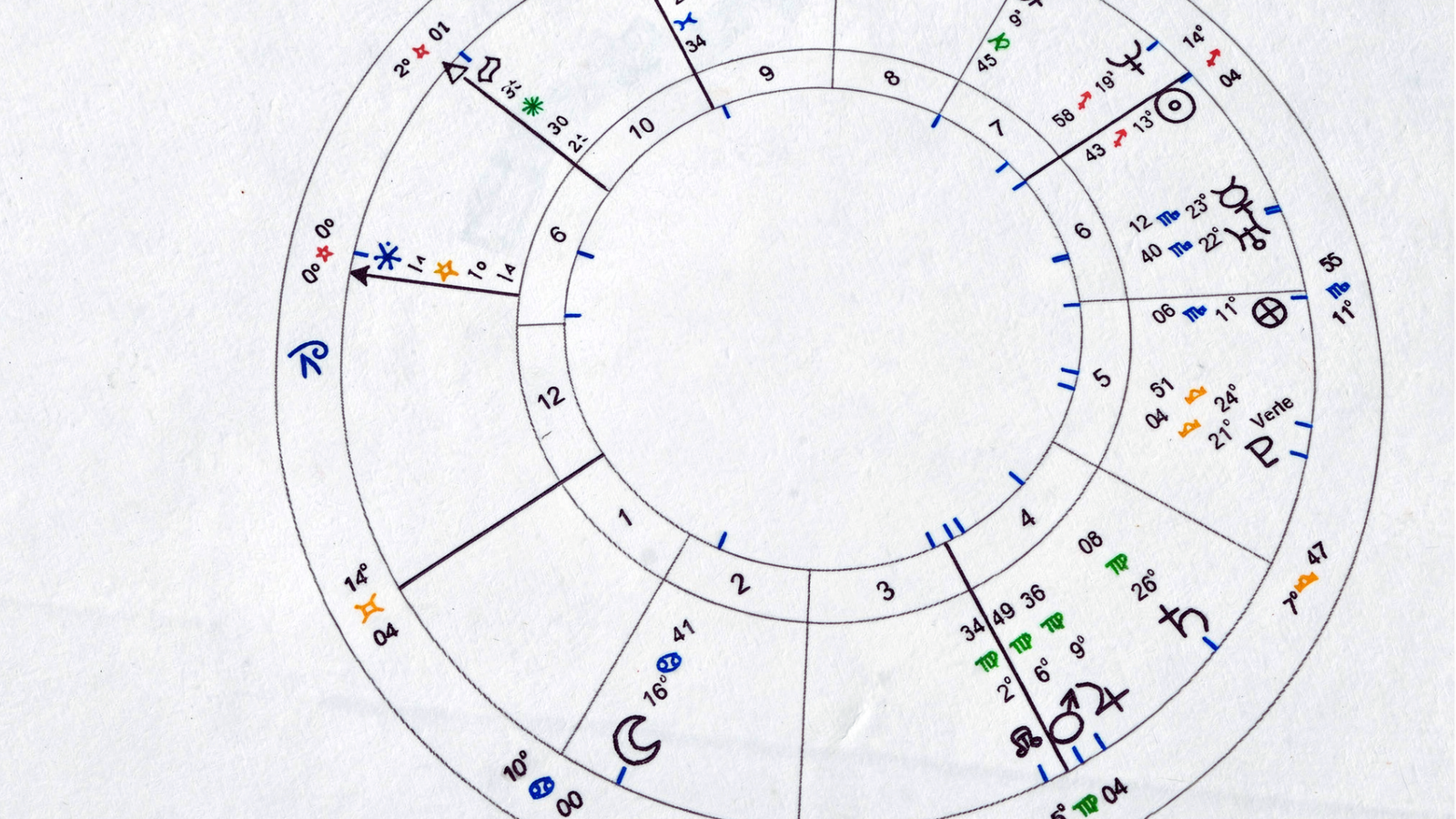
Also known as a natal or astrological chart, a birth chart is a mirror of the cosmos at our birth. It is literally a visual representation noting where the Sun, Moon, and planets were positioned, relative to each of the zodiac signs, on that particular date. Consider it a snapshot that captures and records the astrological influences on our unique existence.
Birth charts are typically depicted as circular maps to show the perspective from Earth. From our vantage, the Sun appears to travel along a specific pathway against that backdrop of constellations. The Moon also travels along this trajectory, as do the planets. At any point in time, they sit within one of the twelve constellations that, over time, have become known as the zodiac signs: Aries, Taurus, Gemini, Cancer, Leo, Virgo, Libra, Scorpio, Sagittarius, Capricorn, Aquarius, and Pisces.
It is a fundamental belief of astrology that not only is the cosmos reverberating with meaning, wisdom, and intelligence, but that human life is subject to these cosmic rhythms, which affect our psyche, spirit, and the way we show up to life. Celebrated psychological astrologer Howard Sasportas once explained, “Whatever is born at a moment of time reflects the qualities of that moment.”
A birth chart depicts layers and layers of symbols, each representing a zodiac sign, a planet, or other cosmic body. Although many of us are aware of our Sun sign, our birth chart shows us our our Moon sign, our rising sign, our Mars sign, and so much more. It weaves in house systems, aspects, and calculation points reflecting the multitude of worlds that exist within each of us—sometimes contradictory, sometimes harmonious, and always with different colors, textures, and directions.
This circular birth chart commonly used in contemporary astrology has roots in Hellenistic astrology, a system believed to emerge along the Mediterranean between the second century BCE and seventh century CE. It is thought that earlier astrological systems, such as those found in Mesopotamia, Babylon, and ancient India, did not originally use the wheel. Rather, they recorded planetary placements and rhythms through lists, diagrams, even square charts, some of which are still common in certain traditions.
How to Read a Birth Chart
A birth chart is typically read beginning at its outermost layer, a circular band comprising each of the 12 zodiac symbols that mirrors the ecliptic. Working inward, the second circular band, closer to chart’s center, contains the astrological houses, which are the 12 different realms of life experience, including work, relationships, self-expression, and more.
Found among these two circular bands are symbols, each representing the Sun, Moon, or planets of Mercury, Venus, Mars, Jupiter, Saturn, Uranus, Neptune, and Pluto. Where these planetary symbols are situated in your birth chart illustrate which zodiac sign and astrological house each planet was transiting at your birth.
Planets
In astrology, the planets are seen as archetypes of consciousness. The Sun symbolizes our core identity, vitality, and selfhood, whereas Venus represents our values and relationship with beauty, harmony, and connection. Each planet reveals a different layer of us and a different function of our wholeness.
Zodiac Signs
Think of the zodiac signs as qualities of consciousness, each one a unique energetic atmosphere through which the planets transit as they progress through the zodiac. The planets are what is being expressed. The zodiac signs affect how that energy tends to move through us and take expression.
Houses
The houses in astrology represent different areas of life experience. They ground the influence of the planets and zodiacs into our lived reality. For example, the third house represents the realms of the mind, such as thought and communication, learning and comprehension. Whereas the tenth house relates to themes of career, legacy, and long-term visioning.
If the planets are the what and the zodiacs describe how, the houses are where these energies flow through our lives. For example, if Venus in Leo describes the manner in which someone loves, Venus in the tenth house describes where that tends to become visible in everyday life.
Lines connecting different symbols to one another in a birth chart are called aspects. They represent the angles between the planets at the time of our birth, which in turn reveal how different parts of our psyche interact with one another.
The Takeaway From Your Birth Chart
Although it is technical and intricate, the system of astrology—and, by extension, the birth chart—is based on connection. Connection with the cosmos, the planets and stars above, the cycles of nature, and the vaster existence of which we are a part. Astrology has been formed over thousands of years. It is grounded in observation, and shaped, refined, understood, and passed down as a language of the psyche capable of revealing patterns, tendencies, gifts, and cycles within each of us.
From this perspective, the birth chart is not deterministic, predetermined, nor fixed. Rather, it is an evolving tapestry of what it means to exist in the world as you. A birth chart does not tell you who you are. It invites you inward to explore the never-ending world of who you are. It helps you remember your intrinsic belonging. And it reminds you what it means to experience life with its—and your—vast potential.